Planes, trains (and loud automobiles)

Standard

Today I’ve notched up a new continent. My first trip to the US of A.

The British Airways flight was suspiciously quiet, and I had a row of three seats to myself. I therefore fashioned a longitudinal bed from it and spread myself out, smug in the knowledge that those up front in the real flat beds would have paid considerably more for their tickets.

The food was passable – tarragon chicken breast for lunch, with a tasty chocolate and caramel mousse. The drinks service was much more regular than on other long-haul flights I’ve taken.

I decided to prepare myself for the American Dream by watching Nebraska. It was in the ‘comedy’ section of the entertainment guide, but was very, VERY slow. Nothing much happened at all, in fact. Already bored of America, I chose Richard Curtis’s About Time for the second film. What can I say? Brits are just funnier.

Much of the flight was over water, but the part over Canadian territory was fascinating. The ice floes in the Gulf of St Lawrence created an ever-changing Arctic patchwork, and I may have even seen a polar bear from 39,000 feet. It was off-white and it moved, so I’m counting it.

Canadian ice

The approach to JFK was also interesting. We flew the length of Long Island, affording views of the beach and (more importantly) the railroad. As if from nowhere, the towers of New York City sprang into view, looking uncomfortably crammed in to the limited space of Manhattan Island.

2014-03-21 17.11.07

Immigration procedures were efficient, and my first task was to navigate the New York Subway system. Purchasing the ticket was the first challenge… and I saved myself a dollar by buying from a real person rather than a machine. Top travel tip there.

The subway has been described as ‘complicated’, which is probably true. Some lines have local and express variants, take different routes during rush hour, or arbitrarily switch tracks because of supposed engineering works. My main navigation issue at Jamaica station, however, was the ‘elevator’. I knew that Americans don’t bother with such trifles as ‘ground floor’ and therefore start their numbering at 1. But I’d blithely assumed that ‘B’ (for ‘basement’) might be the logical choice for an underground railway system. Not so. It transpired that ‘A’ was the correct floor for the subway station. I still cannot fathom what it stands for.

And so, 90 minutes after touching down, I was checking myself into the Broadway apartment that I’m housesitting for the next few days. A quick McDonald’s later (minty Shamrock shake for St Patrick’s Day!) and I was very much ready for bed. But as head hit the pillow, I realised that sleep was not going to be easy.

It seems that in New York, there is a fire every 2.5 minutes. And New York fire engines make a LOT of noise. Also, it seems that the city’s taxi drivers use their horn at least as frequently as their steering wheel. Furthermore, the New Yorkers on this particular part of 96th St appear to be unable to talk to each other. Instead, they shout. Which is audible even on the twelfth floor of an apartment block.

In short: it is LOUD.
Czeching in

Standard

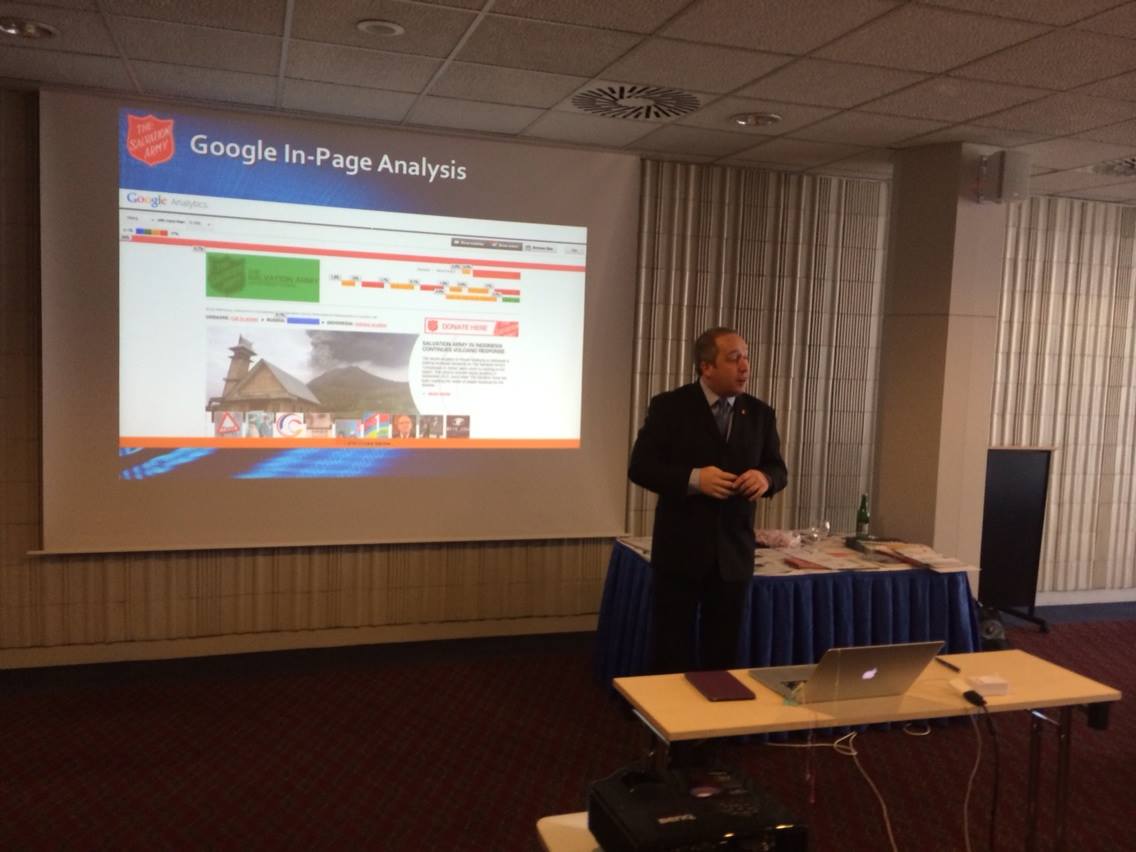
Me at work

I’ve been presenting on web and social media best practice at The Salvation Army’s European Communications Network gathering in Prague today.

It was a mixed group, with various disciplines represented, so it was a challenge to cover the basic essentials while also stretching the other web practitioners. But we managed to cover topics as diverse as Google In-Page statistics, eye-tracking ‘heat map’ analysis, responsive design for mobile, different approaches to engaging and seeking interaction with website visitors, Facebook Power Editor, Twitter optimisation (including a fine example of the Danish rail operator favouriting a Salvation Army tweet right on cue).

It seemed to go pretty well. Colleagues from Germany and the Netherlands are also sharing some of their experience – I’m looking forward to the segment on harnessing Pinterest. I’m presenting again on Wednesday… this time with a specific focus on Twitter.

ICE, ICE, baby

Standard

Fear not. I’m not about to segué into hiphop. The ICEs in question are Deutsche Bahn’s intercity trains, which I’ve sampled extensively on a business trip to Prague this weekend. Typically, it was the British rail network that let the side down.

After an on-time departure from St Pancras International, the Eurostar whizzed purposefully through foggy Kent… until dithering about after the pick-up at Ashford. 186mph became 1.86mph, and we eventually ground to a halt entirely. The guard apologised for the delay, anticipating a 20 minute fester ‘due to signalling problems’. That came and went, as did the subsequent ’15 minutes’. Over an hour elapsed before the train eventually passed sous la Manche, though the irritation was tempered by the offer of a free Eurostar ticket by way of compensation.

Armed with my brand new European Timetable, I’d factored in plenty of time for lunch and a quick stroll around Brussels before boarding the 1425 ICE to Köln.

ICE at Bruxelles Midi ICE driver Yes. That’s the driver. There is a panoramic viewing area at each end of the train, where one can observe the line ahead. Very civilised.

I changed trains at Köln, on to an older IC train along the western bank of the Rhine. This afforded some very pleasant views as dusk fell.

The Rhine

After a final ICE leg from Mainz to Frankfurt, it was time for dinner and bed.

The ICE action resumed on Sunday morning with a high-speed burst to Regensburg (no, I’d not heard of it either). I left my prime viewing position during the journey in order to sample Deutsche Bahn’s breakfast offering.

DB breakfast

Not bad at all.

Regensburg seemed to be a pleasant mid-sized German town but, with only an hour to pass, my explorations were not thorough. The sound of the church bells ringing and the warmth of the spring sunshine as I ambled around the park was suitably evocative though.

Regensburg

The final leg of the journey was via Plzeň to Prague on Vogtlandbahn. This sounded like a railway devised by ill-humoured extra-terrestrials in Hitchhiker’s Guide to the Galaxy (Vogons being ‘bad-tempered, bureaucratic, officious and callous’). In the event, the guard – although demanding ID as well as ticket – was perfectly pleasant… ‘have a nice day’.

And I did. An on-time arrival gave a couple of hours for sightseeing in the Czech capital before the conference began with dinner.

Vine is Fine

Standard

I wasn’t expecting to try something new today, but my job is rarely predictable.

And so, it came to pass that one of my colleagues (keen to plug the excellent All the World publication that he edits) pointed me towards the Bristol Rovers website and something that he’d found ‘interesting’.

Twenty minutes later, I’d installed the Vine app on my spangly new iPad and had created something that warmed the cockles of his heart (and launched The Salvation Army into the uncharted waters of another social media phenomenon).

Vine is wonderfully simple. Six seconds of looping video is just enough to convey a message in a world that has a rapidly-decreasing attention span.

Here’s my first attempt. What do you think?

https://vine.co/v/hLOPiaIFhOt


God’s Cadets

Standard

While the majority of my work for The Salvation Army is for the organisation’s international headquarters, the big topic of discussion in the UK this week has been God’s Cadets – a 90-minute documentary for BBC Four which aired on Tuesday.

The programme followed a group of people who have decided to become Salvation Army officers (church ministers) through their training at William Booth College. Reaction to the broadcast, it’s fair to say, has been mixed. Interestingly, however, the more negative responses appear to have been from Salvationists while those from elsewhere in the Christian spectrum have been generally more positive.

Amid all the criticism about the participants’ flippant remarks and dubious theological understanding, the fact that this was not a Salvation Army recruitment video has been overlooked by some. It was an independent production by True Vision for the BBC, who retained editorial control.

As it happens, I was present at one of the filming sessions. The True Vision crew were at the ‘commissioning’ service in London that saw the cadets progress to fully-fledged Salvation Army officership. My role there was to help with the live webcast of the meeting. Strangely enough, we received complaints about that as well.

Whatever the rights and wrongs of some of the cadets’ comments within the programme, it has been a real conversation starter. Facebook and Twitter were ablaze with comment – good, bad and indifferent. Theology has taken centre-stage in the British media (eg the Daily Telegraph‘s The Pope and The Salvation Army article, which has itself received a reaction).

Perhaps most striking is the response of the UK Salvation Army’s leader, which reveals that – as a direct result of the programme being broadcast – at least one person has become a Christian, another couple has made the non-trivial decision to follow in the cadets’ footsteps and offer themselves up for training, and important conversations have been had about faith, healing and trust.

ChristmasBirthdayWeddingNewYear

Standard

Whew. That was something of a whirlwind.

I’m pretty sure that after a fortnight of ‘not being at work’ I’m less relaxed than I was when I started.

It’s not been an easy couple of weeks, not least because the girls have been out of routine – something they do tend to struggle with at the moment. There’s been present envy, despite our best attempts to be even-handed while reflecting their own preferences and interests.

It’s also been difficult because I’ve been ill for the majority of the break, culminating in a particular unpleasant bout of something-or-other in the early hours of New Year’s Day. Yeucch.

On a more positive note, we had a very lovely family day on Boxing Day which included a spontaneous Chinese dinner. The girls were delighted to try eating with chopsticks, and they were much more adventurous than usual in trying new food.

We also enjoyed our trip to Cadbury World (or ‘chocolate land’ as elder daughter insists on calling it) and our friends’ wedding was lovely too.

The moon on a stick

Standard

It’s official. My eldest daughter looked longingly at the moon on her way back from the hairdresser’s this evening, and expressed her desire to ‘give it a cuddle’.

Which leaves me just over two weeks to find some plausible lunar-alternative, or we’re going to have a very disgruntled five-year-old on our hands this Christmas.

Meanwhile, her sister has comparatively parochial designs on a road-sweeping vehicle (the giant vacuum hose attachment receiving particular acclaim).

Whilst it seems unlikely that either of the younger Gileses will be receiving their present of first choice, we have been keen to encourage the current fascination for hoovering. We have offered many, many opportunities to ensure vacuuming fulfillment.

We are hoping the domestic prowess may, in time, spread to washing, ironing, light garden maintenance and the like. That would make a wonderful Christmas present.

Mad about Madiba?

Standard

On Thursday (5 December), a massive storm surge was wreaking havoc along large parts of the east coast of the UK. Sea defences were breached, houses and livelihoods flooded, thousands of people evacuated. Unsurprisingly, the country’s news media were feverish, as they reported too on the Chancellor’s Autumn Statement. Until just after 9:45pm, that is.

For that is when, in a broadcast that spanned the globe, South African president Jacob Zuma announced to the world that Nelson Mandela had died. Suddenly it was as if nothing else mattered.

The passing away of any other 95 year old may have gone unreported, unnoticed to all but his closest family. But this was no ordinary man.

I remember watching similarly wall-to-wall news coverage when Mandela was released from prison in 1990. That he went on to be South Africa’s first black president represented an incredible social and political change, and the downfall of the abhorrent and inherently unjust system of apartheid.

But Mandela was not a universally loved figure. Biographer Anthony Sampson refers to the mythology that surrounded him, turning him ‘a secular saint’ and which was ‘so powerful that it blurs the realities’. Certainly, many of the tributes from commentators over the last few days have been almost too glowing. Mark Steel has blogged about this eloquently, wondering if it was ‘like this 2000 years ago when Jesus died’.

Something about this pseudo-veneration grates. As it did when Margaret Thatcher died (and DJ wags were banned from playing certain Wizard of Oz numbers). As it did when Diana, Princess of Wales, left this mortal coil.

Freud (another more erudite mind than mine) puts it thus: ‘We assume a special attitude towards the dead, something almost like admiration for one who has accomplished a very difficult feat. We suspend criticism of him, overlooking whatever wrongs he may have done.’

Why do we feel the need to sanitise or polish up a recently-deceased person’s CV? Is it simply respect? Or is it actually because we don’t like talking about death very much, and need something ‘nice’ to paper over the cracks? Can it be socially acceptable to strike a balance?

Madiba – for all his faults – achieved great things, changed a good number of lives for the better and, crucially, argued cogently and authentically for forgiveness. And that’s something we all need.

Dad-vent

Standard

‘Tis the season to be running around like a mad thing.

The manifold wonders of nursery/school/church nativity plays are nearly upon us, and with it comes a social diary that hasn’t been quite so full since I was five. Christmas fairs, parties, dads and kids cooking morning, dress rehearsals for our fledgling angels (oh, the irony).

All of this is superimposed upon a weekly schedule that already includes school runs, phonics practice, meal preparation, and all the 1001 other things that looking after two small children involves. Oh, and the day job (which is itself massively busy in the run-up to Christmas, with a webcast link-up between three countries to get ready for). And extra bits like stepping into the musical breach at church for Sunday evening’s service.

Undoubtedly mums get it worse (and grandmothers – to whom unceasing thanks are due for working wonders with distinctly substandard seraphimic apparel). But I am cream-crackered already, and we’re still three weeks off the Big Day.

The prospect of a couple of weeks off work is most appealing. Except it doesn’t really work like that any more. Gone are the days of long lie-ins, back-to-back 24 and methodically working through a biblical expanse of chocolate. Instead, it’s a case of being leapt upon at an indecent hour of the morning by two small pirates/princesses/bees, back-to-back CBeebies and wondering who to blame for the ludicrous invention of Advent calendars that introduce chocolate (and, ergo, sugar) into the children’s diet before breakfast.

How does one simplify life in the run-up to Christmas, relax and find time to actually focus on the things that are really important? I do not yet have a solution. Or at least not one that doesn’t involve wrapping the girls up instead of the presents…


‘I’m back’ (to Bitcoin a phrase)

Standard

I’m back!

And over the coming weeks, I’ll be sharing some of the joys and horrors of being me. Insights from the world of the web and social media (that sounds posh), perplexed musings about the latest exemplum of ‘customer service’ to get my goat, ruminations about Christianity, the occasional travelogue (when not stuck on South West Trains near Bentley), and anything else that needs to be dislodged from my brain and happens to fall this way.

So, to get the show back on the road. Here’s a thing: Bitcoin.

As you may have read elsewhere, there may (or may not) be £4 million of buried treasure on a landfill site in South Wales. Ahoy, me hearties, etc.

Even before this revelation, my mind was being mildly exercised by the issue of whether it is ethical for a charity to receive donations in Bitcoin.

Bitcoin is ‘a consensus network that enables a new payment system and a completely digital money. It is the first decentralized peer-to-peer payment network that is powered by its users with no central authority or middlemen.’ Still confused? OK, Bitcoin is ‘pretty much like cash for the Internet’ (source: bitcoin.org).

Being a responsible sort of chap, I consulted. One of my colleagues responded with ‘What’s Bitcoin?’. Not an unreasonable question, though I may have been somewhat harsh with my taunts of poverty in response. (According to currency exchange website xe.com, a Bitcoin is currently worth over £600. Though as it’s not legal tender in any country, the value is somewhat moot anyway.)

My other colleague responded even more negatively, pointing out – quite correctly – that Bitcoin is believed to be the currency of choice for transactions that organisations might not especially want to be fully audited. Arms, drugs, people… that kind of thing.

But can a currency – or pseudo-currency – be intrinsically ‘bad’? Should we eschew sterling, dollars and yen because illicit buying and selling has been going on in those currencies since time immemorial? Given that my musings were taking place at the same time as the boss of Co-operative Bank (‘the ethical bank’, no less) was being outed for all manner of inappropriate behaviour, I’d argue that the behaviours of individual users of any financial system cannot transmogrify some kind of morality on to that system itself.

Bitcoin is in the ascendancy. Whether its surge of popularity continues is a question taxing greater economic minds than mine. But if a supporter wishes to give a Bitcoin donation to charity, would it be prudent to accept it? What do you think?